Showing posts with label saddle fitting. Show all posts

Tuesday, 23 July 2024

My Saddle is Adjustable - I Shouldn't Need a Saddle Fitter


Over the last few years adjustable saddles have really come of age and a large percentage of saddles sold these days are adjustable in some way, shape or form.
 

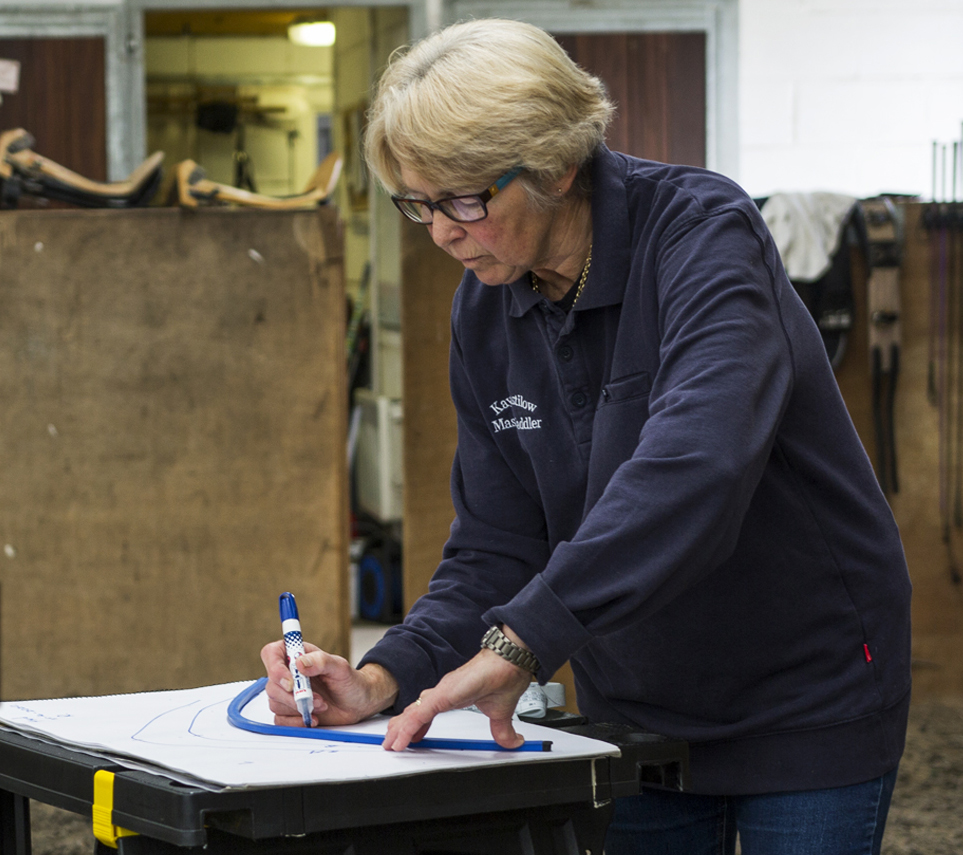
Master Saddler and Master Saddle Fitter Kay Hastilow looks at the reality around this increasingly discussed question...


There are many different methods of adjusting saddles, including tree squeezers, click bits on the tree points and a multitude of adjustable bars, this latter, when done correctly being the most common and successful in my opinion. Surely then this is all you need? Choose the saddle that you like, make sure it’s the right width fitting (easier said than done) and away you go! Where is the problem with this? No need for a saddle fitter and they are always so hard to get hold of anyway. They are always so busy! (I wonder why?) Here are some reasons explaining why fitting your own saddles isn’t such a good idea.

The first problem is that not all adjustable saddles will fit all horses. Some horses, such as but not exclusively, those with high, long withers (think thoroughbreds amongst others) need more support down the front of the tree points, which themselves will need to be longer, therefore needing a longer bar. Conversely, use a tree with long points and a long bar on a cob with a broad back and it is likely that there will be excess pressure either side of the back behind the shoulders. Also, the points may well stick out and catch the rider’s leg as they don’t follow the curved shape of his back. These shaped equines need a shorter bar, preferably more open at the head. In other words it’s more like an upside down U rather than a V.

Using a tree with short points on the more angular high withered horse means that the panel is not supported beyond the point ends. As a result, the saddle is ultimately supported by the rib cage of the horse. Although there is muscle and fascia above the ribs,  muscle works by expanding and contracting but cannot, of itself support weight. This is easy to prove for yourself. Make your thigh muscles as tight and rigid as you can. Press your thumb into it. See? It sinks into the muscle, doesn’t it?  

It's also the case that in high withered horses, the rib cage starts considerably lower down the horse’s sides than in a cob type and the muscle there can no more support the saddle and rider than the muscle in your thigh can support your finger. This is why the currently popular short tree points on many saddles need to be so much narrower than anything that I have fitted for many years. These tree points will put direct pressure through the muscle causing atrophy and scarring. Also, these saddles usually drop onto the wither so several pads are needed to get clearance. Err… close contact so that you can feel the horse – with loads of pads? This doesn’t equate for me but perhaps you see it differently?

Having decided on the type of saddle that you think will suit your horse, what width bar do you need? You might take a guess and you might be right but in my experience the more common problem is that too wide a bar is used. Thinking that wider is better for the horse is so totally wrong, as Russell Mackechnie-Guire’s work undertaken for The Society of Master Saddlers has proved. A bar that is too wide just causes all the weight to concentrate under the front third of the saddle, resulting in huge areas of excess pressure, often leading to white hairs, if not open saddle sores, behind the shoulders as well as restricting the movement of the horse. No, the muscle will not develop here if you allow space for it. The excess pressures will in fact cause the opposite effect, as many have found to their cost.

Having seen the importance of the length of the tree points, you now feel able to order the right saddle. He’s a thoroughbred so long tree points. Check. But hold on a minute? Is his back level or is he a bit uphill or downhill? Does he change when ridden? This will dictate the depth of rear gusset that he needs, so now you will at least need a friend to film you riding to see this - but hold on! Horses don’t always go the same in one saddle as another, so might be different in the adjustable saddle that you are going to buy….  Have to take a guess then.

This is the same in reverse for cobs. You might well need little to no rear gusset or a fairly deep one. Suddenly this isn’t looking just so easy is it?

Tree shape is next. Flat in the back or curvy? Something in-between? Tree types for each, both with long and short points. Mmm.

What about girth straps? Well everyone knows that you use the first and third don’t they? Not necessarily so with adjustable saddles. Many have several strap positions so that the saddle fitter can find the optimum girthing arrangement for you and your horse. With many, the first strap is attached to the tree points, a point strap. This is to help position the girth straps vertically with a forward girth groove. In this case a point strap is a preferred option, as otherwise, the saddle moving forward onto the shoulders will restrict movement and be uncomfortable for the horse. However, if the point strap isn’t needed, using it will tend to hold the saddle too far back and is likely to pull the front of the saddle too low on the withers.

For saddles with five strap position options the equivalent of 1 and 3 is 2 and 3. The fittings that you can fit straps to at the back are for when point straps are being used to prevent the back of the saddle lifting, or where an active horse tends to bounce the saddle at the back (so long as the front is fitted correctly and isn’t too wide). Another use is to help keep the saddle straight when either the horse’s action or an unbalanced rider tends to take the saddle over to one side. This usually calls for slight and skilful flocking adjustment as well, not something that the owner should be trying.   

Talking of flocking adjustment, this is one of the things that saddle fitters will usually have to do when fitting even an adjustable, as often the saddle will need a touch of wool here or there so as to get the balance, contact and straightness correct. Those who have had the misfortune to see a badly flocked and lumpy saddle will realise that it’s very easy to get flocking very wrong.

It is because a saddle fitter will be aware of all of the questions above plus many others and have answers to these that it is still necessary to have your saddle professionally fitted. One of the leading manufacturers of adjustable saddles will only sell through qualified saddle fitters so that their end user will get the very best out of their saddles.  And you know how busy saddle fitters are? Much of our work is sorting things out when someone has gone the DIY route. Often this has caused the horse pain or discomfort and often the saddle has to be replaced as you have bought something unsuitable. This can become a very expensive cost cutting exercise!

Like many riders and trainers, you've probably thought at some point that understanding more about saddles and saddle fitting would have the potential to help you improve your horse's comfort, performance and also long-term soundness - and not only are you right, you can now do that online, whenever and wherever fits into your busy lifestyle.

Saddle Fitting Videos from Kay Hastilow

With online learning and training now much  more familiar to us all, Kay's highly acclaimed and informative 2-part video series continues to sell around the world since its launch in 2019. Aptly titled Saddle Fitting Know How - For Riders and Trainers, the two videos distil her 50 years of experience into over an hour of what is an unrivalled go-to resource for all Riders and Trainers interested in saddles and saddle fitting. They contain a wealth of information that will be of practical relevance to everyone serious about improving their riding, competing with more success or at a higher level and for those whose career is focused on training riders to develop their horses correctly.
Watch a brief trailer and buy securely online for unlimited streaming or downloading to your device at

https://vimeo.com/ondemand/saddlefittingknowhow

If you are working as a saddle fitter or in training for a career in saddle fitting, Kay's 8-part video series titled Fitting Saddles: The Essential Guide will support your learning and help you develop a more in-depth knowledge of the subject and include invaluable insights into running a successful business as an SMS qualified saddle fitter.

Watch a trailer and invest in one or more of the series that together form a definitive resource to enhance your understanding of saddles and saddle fitting.
Buy securely online for unlimited streaming or downloading to your device at
https://vimeo.com/ondemand/fittingsaddles


Thursday, 3 November 2022

Why Saddle Fitting is Not a Magical Cure for Chronic Issues in the Horse


For this post Kay Hastilow welcomes Guest Blogger Rachael Argo, who like Kay, is a Master Saddler and Master Saddle Fitter. Originally from Scotland, Rachael now lives and works in Portugal.

This is an article I have been debating about writing for some time. After more than 20 years of saddle fitting, I have seen so many horses set up for failure by owners who have chosen the wrong route and ended up with chronically lame or injured horses. 

These horses’ working lives have been cut short needlessly for various reasons, some of which include lack of knowledge, not having access to a team of professionals who are familiar with equine rehabilitation, not following good advice from knowledgeable professionals, wanting to ride at all costs, being in too much of a hurry and not ensuring the horse was ready and fit to ride, costs and sadly sometimes just not wanting the hassle of rehabilitating their horse.

I cannot count the number of times I have been called out to assess saddle fit on horses because they have problems. Perhaps the horse’s performance has diminished, he has behavioural issues, the rider is slipping to one side and so on.

In most cases there I have found that poor saddle fit has played a part in the overall issues. In most cases there are also other issues underlying, for example, pain, mental distress from pain, arthritis in joints, soft tissue injury, poor hoof balance, teeth problems, poor bridle fit and bitting, riding techniques that are detrimental to the horse, use of gadgets like draw reins, pessoas etc. The easy part to alter is the saddle and bridle fit and the bit. These can be changed quickly to more appropriate tack that halts the cycle of re-injury that occurs each time the horse wears the tack.

HOWEVER this is where it gets more challenging. Once the offending tack has been changed to more suitable tack the owner often believes that all is now good, the problem will now magically disappear and the horse can resume not just normal work but actually increase the work because that is what the owner wants.

WRONG. WRONG. I say this over and over.

I cannot emphasise enough just how false this idea is. I can, and have, repeated this statement hundreds of times and yet I still have clients that it is not getting through to.

It is common to find horses that have had poorly fitted tack for a year, two years, ten years. A horse cannot have poorly fitted tack for any length of time without sustaining chronic injury and a resulting alteration of his gaits ie he will adapt his movement to try and minimise the damage to his body. It is not a big jump for rational people to make the connection that this change in gait will affect the horse’s whole body, his muscles, tendons, ligaments, bones. To simplify this concept the horse now has excess wear and tear on his whole body, he is suffering from chronic long term pain and injury. So WHY is he immediately expected to get back to full work and be sound????

If an athlete had been running for a year in badly fitting shoes and had gradually lost their speed and endurance and started to have pain and injuries, you would not simply give them new shoes and expect them to immediately to go back to running and to perform at a higher level than before with only a couple of days off and one physiotherapy or osteopathy treatment. You would expect months of careful and slow rehabilitation to re-educate the body. The ‘wrong’ muscles would need to diminish and the right muscles would have to be slowly built up. All of the soft tissue would need time to adapt to a new way of moving and be allowed to develop to support the joints. All of that is assuming that a long time of moving unevenly or in a less than optimal way had not caused skeletal damage. If there was bone damage, then a whole different approach would need to be taken. In all cases a thorough medical assessment would have to be undertaken to see exactly what damage was apparent before a successful rehabilitation programme could be developed.

So why is it different for horses? Why is it a common belief that changing the saddle will fix all of the problems with just a session or two of complimentary therapy treatment? And when it does not solve the complex plethora of problems and the horse starts to lose performance or the saddle slips to one side the saddle fitter is summoned to ‘fix’ the saddle because it ‘doesn’t fit’. And when they ask the question ‘Did you get your vet to come and do a work up to check for pain and lameness?’ the answer is usually ‘no’.

My best guess as to why this happens is that owners cannot believe the horse could have profound and far reaching injuries because they are not on three legs or bucking riders off.  The horse has learned to ‘cope’ with the chronic pain and injury because he has to and it is his nature as a prey animal. It is also that the rider can see the saddle and bridle. They are tangible objects and often changes in the horse come after a saddle fit therefore the saddle or bridle must be to blame.

Most times we already have the information that the horse has always thrown a saddle to one side or not picked up one canter lead or not been able to bend one way. The situation gets worse after the saddle is changed because the horse is being asked to change his entire way of going. He has to carry the rider in a different place, a different balance, and he is simply not equipped to do so at that moment. Because he is a horse and they are generally very accommodating animals, they will often try for their riders. In some cases the horse may feel better straight away because the saddle is no longer pinching so he may go a bit better initially. Often the owner will misread the situation and take this as a sign that they can increase the horse’s work. Over a short time the horse will start to break under the strain. The first sign for the rider is often the saddle starting to slip more to one side. It is not the first sign of issues but it is often the first one the rider notices. (Recent research from Centaur Biomechanics and from S Dyson and D Pollard - The Ridden Horse Pain Ethogram - has correlated saddle slip with hindlimb lameness) At this point the rider will do the 1+1 = 256. The saddle was changed, the horse is losing performance or saddle is slipping therefore the saddle fit is to blame.

How lovely it would be for all of us if a simple change of saddle could not only enhance the rider’s ability and make the horse feel better but it could miraculously undo all of the damage that has been done to the horse over the last year, five years etc. Sadly this is not true. The saddle fit is the first step to breaking the repeating cycle of damage. It is the first step on a long road of rehabilitating the horse. I always recommend that the horse be assessed by a vet and a qualified professional in whichever other modality the owner chooses to help the rehabilitation process.

Ideally the saddle should not go back on the horse until all of the rehab assessments and work are done. In some cases I will fit a saddle sooner than is ideal but with the caveat that the horse needs careful treatment and reintroduction to work. This is only in the case that I am a long way away from the client and know I cannot get back in the shorter term. In some cases I will refuse the saddle fit if the horse is obviously lame, thin, in pain etc. In other cases the horse does not appear to be too badly off and work is needed to help build up muscle and straighten the movement. When I hear the work has not only been resumed with no rehab involved, but has been increased and now the horse is really struggling, my heart sinks. In this case I will refuse to refit the saddle until the horse has been assessed and cleared for work by the vet. It will not make me popular but all equestrian professionals should be advocating for the horse and have a duty of care to tell the owner what the horse needs them to hear, not necessarily what the owner wants to hear. It is difficult for professionals to risk losing clients because they have to make money to live, but short term gain will be offset by long term loss if the horse becomes unfit to work.

So the next time your saddle slips or you are questioning why your horse is losing performance it is worth considering the bigger picture. Nothing happens in isolation and saddles can only go where the horse and rider put them. They cannot move on their own. Saddle fit issues can sometimes be the problem but more often they are an indicator of a much more complex problem. You need a team to get to the root cause and help formulate a plan to keep your horse healthy and sound.


Friday, 4 June 2021

Busting Myths 20 - My Horse Has A Short Back But I Am A Big Rider ...


There are many myths that have been going around with regards to saddlery and the use thereof. In this series of posts, I endeavour to show most of them are without foundations and can, in some cases, be the opposite of the actual facts.

Pictured right is author Kay Hastilow, Master Saddler and Master Saddle Fitter.


'My horse has a short back and despite me being 5'8" and 11½ stone I am told that I MUST ride in a 16" saddle as that is all that he can take. Can this be right?


Edited image to illustrate the issue.

I
t is a fact that, at the same time as our riding population is becoming taller and heavier, horses are being bred with ever shorter backs. Whilst we know that a short back is stronger than a long back and considered good conformation, there is a limit to all things. Would a horse with just 6” (15cm) between the leading edge of the scapula and the last rib / T18 be considered to have good conformation? Would it be of any use to anyone? I think not, but here we are with these short backed horses and their tall, well-padded riders.

What then is the solution to this? To my mind having a saddle far too small for the rider doesn’t help us at all. Our rider mentioned in the question would be most comfortable in an 18” saddle, 17 ½ at the very least, so to put them in a 16”, as is so often insisted on by various no doubt well-meaning people is a recipe for disaster. For a start the rider will be so uncomfortable that they will be constantly moving in the saddle trying to find a place to sit. They won’t manage it – it really isn’t possible. The constantly moving rider is changing their balance every time and the horse will have to try to rebalance the rider and themselves. That’s very tiring and certainly not going to help their concentration and so this will limit their ability to work as you would wish. Not only this, but the rider’s weight, the downward pressures and upward forces will all be concentrated in a very small area making it nigh on impossible to distribute these pressures and forces as is necessary to prevent damage to the horse’s back. Now that CAN cause a ‘sore back’!

Another solution sometimes used is to fit a shorter panel to a larger tree. Very clever. Now the rider’s weight is concentrated exactly where the panel ends. Well, I suppose at least the rider is more comfortable….

Often these shorter saddles are recommended by some form of paraprofessional, qualified or possibly not, in the massage / physio/ chiropractor / ‘back man’ field. They will have found an area of tightness and discomfort in, say the lumbar area and the saddle immediately gets the blame. Whilst of course the saddle should be checked for fit (by an SMS  qualified saddle fitter ideally) it is often the case that discomfort in the back is a symptom of a hind limb lameness or ulcers and nothing to do with the saddle. It’s just too easy for some of these people to scream ‘SADDLE!’ having the belief, incorrect I believe, that saddles are usually the culprit. In an ideal world a practitioner such as those mentioned will work with qualified saddle fitters so that the knowledge that each has can be shared to the benefit of both horse and rider. It happens occasionally but perhaps not as often as we would wish.

I have two problems with the suggested ‘solutions’. One is that some people take T18 as the point at which the panel of the saddle must end, whereas the actual bearing area of the tree is forward of this point. Beyond the tree the pressures are much reduced through the panel as, with no tree to support the panel it will fold away from the horse’s back to some extent. Also, I have yet to see any proof (or evidence) that having a saddle an inch longer than perfect is going to cause any harm to the horse, and it is certainly preferable to having the rider squashed into a saddle that is too small for them.

The second problem that I have with fitting such small saddles is that so often the saddles are just fitted static, and then condemned as being ‘too long for this horse.’   Often they are not even girthed up, let alone ridden in, and yet we know that when the horse is dynamic the area available for the saddle increases. No, the back itself doesn’t lengthen- if you have ever tried to pull two thoracic vertebrae apart on a fresh cadaver you will know that this is nigh on impossible. However, if you just bring the horse’s head down from standing position to that more adopted for work ( a titbit or some food will achieve this) you will note that the saddle area is increased. Could this be the spinus processes opening? I don’t know, but this increase  can and has been measured, showing between 1 ½ (3.5cm) and 2” (5cm) increase in length from the edge of the scapula to the last rib. That is a huge amount and would, of course allow our tall, well-built rider to have their 17.5 or 18” saddle.

This is easy to prove for yourself. Mark the edge of the scapula and the last rib (use Tippex or insulating tape), measure, then get the horse to change his head position as suggested. Re-measure. Likewise, put the saddle on. Photograph where the saddle sits then work the horse. Film with the zoom lens so that you just are filming the shoulders to quarters of the horse. You will see that the back marker, possibly concealed by the saddle when static is now clearly visible behind the saddle. Before being talked into buying the tiny saddle please try this for yourself. I think both you and your horse will be grateful that you did so. 


Like many riders and trainers, you've probably thought at some point that understanding more about saddles and saddle fitting would have the potential to help you improve your horse's comfort, performance and also long-term soundness - and not only are you right, you can now do that online, whenever and wherever fits into your busy lifestyle.

Saddle Fitting Videos from Kay Hastilow

With online learning and training now much  more familiar to us all, Kay's highly acclaimed and informative 2-part video series continues to sell around the world since its launch in 2019. Aptly titled Saddle Fitting Know How - For Riders and Trainers, the two videos distil her 50 years of experience into over an hour of what is an unrivalled go-to resource for all Riders and Trainers interested in saddles and saddle fitting. They contain a wealth of information that will be of practical relevance to everyone serious about improving their riding, competing with more success or at a higher level and for those whose career is focused on training riders to develop their horses correctly.
Watch a brief trailer and buy securely online for unlimited streaming or downloading to your device at

https://vimeo.com/ondemand/saddlefittingknowhow

If you are working as a saddle fitter or in training for a career in saddle fitting, Kay's 8-part video series titled Fitting Saddles: The Essential Guide will support your learning and help you develop a more in-depth knowledge of the subject and include invaluable insights into running a successful business as an SMS qualified saddle fitter.

Watch a trailer and invest in one or more of the series that together form a definitive resource to enhance your understanding of saddles and saddle fitting.
Buy securely online for unlimited streaming or downloading to your device at
https://vimeo.com/ondemand/fittingsaddles