Friday, 13 March 2020

The Tack Fits - Or Does It?


It has given me great pleasure to see that now, in the UK, the majority of caring horse owners get their saddle professionally fitted.  Many are also good at having the fit checked on a regular basis, but often the thought stops there. Some will also look at their girth, look at current research and make wise choices. However many, perhaps too many will think that they don't really need to consider this, nor the bridle, nor the bit or any other piece of the equipment that we use on our horses. Let’s take a look at other factors that contribute to your horse’s comfort.

Bridles have changed out of all recognition, some of the designs carefully researched, with a lot of research & development (R&D) having taken place. Some less so, and some positively awful. Old style bridles really don't fit modern horses unless they have been made to measure.  Arab horses, warmbloods and thoroughbreds have been used to develop the horses that we ride now and of course, the shape of their heads have changed with these different breed influences. If you are buying an ‘off the peg’ standard bridle, you may well find that the headpiece is too short over the head and in the throat, cheek pieces will be too long, browbands will be up to 2” (5cm) too short, nosebands too small around the face but too long in the head parts. These are the sizes used 50 or 100 years ago, which some of the manufacturers, who rarely if ever look at a horse, have continued to make, believing that they will be a good fit. 

The thing is to look for research, good, repeatable and repeated research, not just a snapshot of some of the research undertaken, as it’s possible to make this show what ever you want. You need to ask what protocols were followed to assess the value of the claims made for products.
I saw a horse recently that wouldn’t turn left, was throwing saddle and rider left and was being very naughty. It had a modern continental bridle on that was strapped up as tight as the owner could do it as he had little control of the horse when jumping. A good rider by the way, and a good horse. In hand the horse moved straight and there were no obvious signs of lameness or gait asymmetry (a vet was in attendance). I changed the bridle to a conventional bridle with a high ring grackle noseband. Certainly not a perfect fit but much better than the modern bridle and within 20 metres the horse had relaxed and stopped fighting his rider. Within 15 minutes he was as soft as you could wish. The saddle still moved a little left, but nowhere near as badly. I found a way to keep it straight by altering the way the girth straps were used whilst the vet investigates to see if she can find any underlying problems. Meanwhile, he is doing really well in his high-grade jumping classes and is a much happier horse.

Nosebands!! PLEASE stop using flash nosebands. If you look at current research with regard to the TMJ (tempero-mandibular joint) and the nerves in the face, you will see that flash nosebands inflict high pressures in all of the wrong places. Research by Fairfax Saddles showed that the best nosebands to use were a drop (yes, that surprised me as well), the high ring grackle or a cavesson, in that order. Good, solid research. It’s worth listening to.

Girths come in many shapes and sizes. One even has elastic bands (vacuum cleaner type) within its construction! There are some excellent options available with solid research to back up their design, but some are apparent copies of these girths, with their purchasers failing to appreciate that although they are similar in shape, key components of the successfully tested design have been missed out. You haven’t bought ‘a copy’ of this or that girth. You have bought an inferior product in many ways
Many of you will know that I detest the use of elastic in girths. One thing that we know about horses is that they like the saddle to be stable as they find it easier to maintain their own and your balance with a stable platform between the two participants. It is therefore unhelpful to add elastic to a girth, especially at one end only. The latter will just encourage the saddle to move away from the elasticated side, so making the saddle unstable. Both sides with elastic risk destabilizing the saddle completely, unless of course you have tightened the girth up so much that the elastic is at maximum stretch. In that case, the girth will have been over-tightened anyway, so what is the point of the elastic? If you watch a horse breathing after exercise you will note that almost all of the rib expansion, such as it is, takes place further back from the girth and that expansion in the girth area is miniscule. You really aren’t helping the horse with this in any way. Most of all, with girths think of any unintended consequences that could come about because of the girth that you use.

Girth sleeves. Great for keeping the girth clean but in many cases,  these are made from synthetic fleece which can heat up and cause a rash on the skin. If made of real sheepskin they can make the horse sweat more than usual in this area and these can be harder to keep clean.The synthetic fleece sleeves  also tend to twist around making pressure points. I have found a stretchy towelling sleeve the best of those that I have tried over the years.


Increasing your own knowledge will help you work more closely with your saddle fitter and your horse will benefit  ...


Kay says; "Knowing when you need to book your saddle fitter is an important aspect of managing all ridden equines. Having spent more than 50 years working with saddles and fitting them to horses and ponies, I have retired from actively fitting saddles and I am now focused on sharing what I’ve learnt to help develop knowledge and understanding of what goes into achieving a correct saddle fit. I feel that video enables me to do that much more effectively than would be possible in a book, I enjoyed the project immensely and am delighted with early feedback from those who have already bought these two videos which are specifically to help Riders and their Trainers understand a little more about saddle fitting and why it is so important for every ridden horse and pony.”
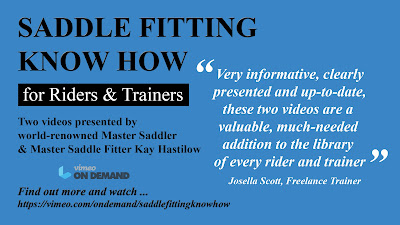
Saddle Fitting Know How - For Riders and Trainers is available as two videos for unlimited download or streaming from Kay’s own Vimeo On Demand page for a one-off charge of just £35 per video – less than the cost of a good quality saddlecloth or a lesson from a trainer! 

The first video looks at Conformation and Movement of the Horse, Types of Tree and their Influence, Different Panels and the Position of Girth Straps.

The second video explains How to Assess a Saddle for Soundness, Straightness and Safety, Recognising a Good Fit, the Balance of a Saddle, When Saddles Move and finally, Rider Influences. 

These two new videos contain a huge amount of information and together they provide over an hour of expert Saddle Fitting Know How. Certain to become a ‘go-to’ resource, one that you’ll view again and again, Saddle Fitting Know How – For Riders and Trainers uses clever graphics alongside clear explanations and insight into many different aspects of achieving and maintaining a correctly fitting saddle.

Find out more and get access to these unrivalled and informative videos at https://vimeo.com/ondemand/saddlefittingknowhow 


Your horse will thank you in more ways than one! 


Click here to buy videos for streaming or download


Friday, 28 February 2020

Horse People and Qualifications; Why Such Disregard For Qualified Experts?

Horse owners need many skills and services to help them keep their much-valued horses and ponies not only in good condition, but also fit and healthy enough to perform the tasks asked of them, whether that be top-level eventing or simply hacking around the woods.

Master Saddler and Master Saddle Fitter Kay Hastilow shares her thoughts and experiences of choosing professionals to support different aspects of your horse's health and wellbeing...

Here are just a few of the skilled people working regularly with horses that that come to my mind - vets., physiotherapists, farriers, nutritionists, trainers, equine dental technicians and of course saddle and bridle fitters . All of these are professional people who have invested a great deal of time, effort and considerable amounts of money into learning their trade and gaining qualifications, so that we can know that we can trust them. They also have to be members of their relevant professional body, (which requires proof of correct insurances held), which oversees the qualifications, deals with complaints and upholds the standard of each profession. All of these memberships will be subject to constant updating of their skills and knowledge through CPD (Continual Professional Development), expensive and time consuming though these are. All so that any QUALIFIED professional whom you employ will be insured, knowledgeable about their subject and up to date on changes and research undertaken in their field. As with all professions, some practitioners will be better than others, but you do at least know that they have all, at some time, shown their ability and do have their professional body keeping a check on all of its members, with insurance behind them.

I find it very frustrating that someone who has spent a minimum of three years to train, say as a saddle fitter, including very expensive courses, modules and working with mentors, and has gained their SMS Qualified Saddle Fitter status after a very tough assessment, is all too frequently overlooked for ‘Wendy down the road who has loads of saddles to try’. ‘Wendy’ hasn’t got a clue just how much she doesn’t know, will happily stick anything on a horse to sell a saddle (these have often been supplied sale or return by a manufacturer with a requirement to sell ‘so many’ a month. No pressure then!) and in 18 months or so they will have had so many complaints that she just shuts up shop and goes off to do something else. Meanwhile, your good competition horse has chucked in the towel and is virtually valueless or, even worse, has been damaged by the saddle to such an extent that expensive veterinary treatment is needed, with no assurance that the horse will ever be the same again. So, what do you do? Complain to their professional body? They aren’t a member of any as they don’t hold the necessary qualifications. Sue them? Ever tried that? Firstly, they don’t have any liability insurance, and it’s expensive to sue someone.One such person who was threatened with this said; "Go ahead. I live in rented accommodation. The saddles don’t belong to me. My car is ancient, and as I need it for work, they won’t take it off me anyway." Lovely.

I know that vets get very frustrated that people will call in ‘the back man’ before calling the vet, often meaning that, by the time they get to the horse the condition has worsened, it will take a lot more time to get the horse right again (if that is even possible now) and often the problem has been exacerbated by the ‘treatment’. I understand, as a horse owner myself, that it can be frightening to call the vet in as bills can mount up very quickly, especially if technical diagnostics are used, but you can always say, right at the start or at any time through the treatment, that you really don’t want to spend that much money. So long as you have a realistic budget there are often options available.

I wonder, would you be happy to have an unqualified surgeon operate on you, even if he has a big following? Or, perhaps have the barber remove teeth for you, as used to happen? Of course not, so why, when you own a precious horse, do you consider using these unqualified people? Often, these folk have great charisma and have a believable line in various theories, but without any testing, evidence or proof.  They tend to ‘take people in’, but so often it all ends in tears.

Someone within my area when I was regularly saddle fitting set up their own business and promptly started rubbishing many of my fittings, being blissfully unaware of many of the factors involved. They had decided that trees should be wider (a theory that sounds plausible, but we know isn’t correct as Dr Russell McKechney-Guire’s recently published work has clearly demonstrated) and promptly started widening the trees in many of the saddles that I had fitted, often with disastrous results. Opening trees on some of the tree squeezing machines is a very skilled job, skills that they did not have, so many of the alterations led to crooked trees, where one of the tree points sat at a different angle to the other. Wide fit on the left, say, and medium on the right. Net result? The back of the saddle will kink over to one side, causing considerable discomfort and possibly injury to horse and rider.

Many of these people came back to me – "I’m so sorry, they were in the yard and seemed so nice, and I know it’s a long wait to get you…(have you ever wondered why good fitters have a long waiting list, while this person can come tomorrow?)" But once a saddle has been opened unevenly, the only real answer is to replace the tree, as trying to correct it is very unlikely to be successful. New trees are expensive! Also, if a tree has been widened, it’s difficult to bring the width back in again without the risk of it opening back out as the rivets have, to some extent been weakened. There were a lot of very unhappy and out of pocket customers around for a while.

Please also be aware that a farrier, a trainer or an equine dentist, say, is not an expert, does not hold a qualification in, nor is registered as a saddle fitter and so should never give an opinion on a topic beyond their speciality - and neither should the saddle fitter comment on other professions. I have, on occasion been told that the physio., trainer or farrier has said that the saddle doesn’t fit. Do you think that we don’t talk to each other? In every case I have spoken to said professional, only to find that what they are alleged to have said is a million miles from the truth. A good professional respects other professionals and will try to work with them rather than against them.

May I ask that when arranging for the saddle fitter, physio or dentist to come out, that you enquire, before booking, what qualifications they hold and whether they hold insurance cover? No fully qualified professional will be anything but delighted to receive such a request and be proud to tell you what they have achieved. Be careful though. Some people in the ‘back person’ and saddle fitting world claim to hold qualifications, when all that they have done is attend a short course, often just a few days, and are given a certificate for this, with no assessment or professional body involved. Ask who they hold the qualification with and look up that awarding body. It’s easy enough on line, where you should be able to see just what was involved in gaining the said ‘qualification’. I know that some saddle manufacturers have their own in-house training, but this is usually for just a week or so. Definitely not long enough to understand anything really!

Increasing your own knowledge will help you work more closely with your saddle fitter and your horse will benefit  ...


Kay says; "Knowing when you need to book your saddle fitter is an important aspect of managing all ridden equines. Having spent more than 50 years working with saddles and fitting them to horses and ponies, I have retired from actively fitting saddles and I am now focused on sharing what I’ve learnt to help develop knowledge and understanding of what goes into achieving a correct saddle fit. I feel that video enables me to do that much more effectively than would be possible in a book, I enjoyed the project immensely and am delighted with early feedback from those who have already bought these two videos which are specifically to help Riders and their Trainers understand a little more about saddle fitting and why it is so important for every ridden horse and pony.”

Saddle Fitting Know How - For Riders and Trainers is available as two videos for unlimited download or streaming from Kay’s own Vimeo On Demand page for a one-off charge of just £35 per video – less than the cost of a good quality saddlecloth or a lesson from a trainer! 

The first video looks at Conformation and Movement of the Horse, Types of Tree and their Influence, Different Panels and the Position of Girth Straps.

The second video explains How to Assess a Saddle for Soundness, Straightness and Safety, Recognising a Good Fit, the Balance of a Saddle, When Saddles Move and finally, Rider Influences. 

These two new videos contain a huge amount of information and together they provide over an hour of expert Saddle Fitting Know How. Certain to become a ‘go-to’ resource, one that you’ll view again and again, Saddle Fitting Know How – For Riders and Trainers uses clever graphics alongside clear explanations and insight into many different aspects of achieving and maintaining a correctly fitting saddle.

Find out more and get access to these unrivalled and informative videos at https://vimeo.com/ondemand/saddlefittingknowhow 


Your horse will thank you in more ways than one! 


Click here to buy videos for streaming or download

Tuesday, 18 February 2020

Why Rider Balance Affects Comfort and Performance


I am constantly amazed that riders (and too often their trainers) are oblivious it seems, to the importance of the balance of the saddle. If they are aware of this, then there are some rather weird ideas as to how to see if the balance is correct. Apparently, you can ‘put a cotton reel on the seat and it should stay in the centre’. Oh yeah! This takes no account of how the horse reacts when the rider gets on.

He may drop his back, in which case the saddle, previously thought to be ‘level’ will be tipping back.  When he is actually working, he may well ‘lift his back’ into the saddle, and it would then be tipping forward. Funnily enough, both faults will make the rider tip forward as the rider attempts to prevent themselves from getting left behind, often bracing their lower back in an effort to stay upright. Sore backs (with the rider) commonly result from this. 

I find that the best way for a rider or trainer to see if the balance is correct is to ride the horse so that he is warmed up and going as you expect and then have someone take a film of this. You can freeze frame it on side views to see, does the saddle look level? Is it tipping back , so that the rider is tipping forward in an effort to stay upright? Is the saddle tipping ‘downhill’, with the rider probably sticking their legs out forward and bracing themselves to stay ‘in position’? 

It is easy to put a temporary pad under the front or back of the saddle to try and balance it and ride with it like this to see if there is an improvement in the rider’s position. If the results are good, then contact your qualified saddle fitter to correct this for you. It might be necessary to use adjusting pads to get the result that you want, and I would suggest that trainers should have a multi-adjustable pad, such as the Prolite thin multi-adjuster pad with them when teaching, as correctly balancing the saddle will greatly improve their pupil’s position.
__________________________________________________________

When you don't know what you don't know ...


Kay explains; “I have spent more than 50 years working with saddles and fitting them to horses and ponies. Having now having retired from actively fitting saddles, I am focused on sharing what I’ve learnt to help develop knowledge and understanding of what goes into achieving a correct saddle fit and feel that video enables me to do that much more effectively than would be possible in a book. I enjoyed the project immensely and am delighted with early feedback from those who have already bought the videos.”

Saddle Fitting Know How - For Riders and Trainers is available as two videos for unlimited download or streaming from Kay’s own Vimeo On Demand page for a one-off charge of just £35 per video – less than the cost of a good quality saddlecloth or a lesson from a trainer! 

The first video looks at Conformation and Movement of the Horse, Types of Tree and their Influence, Different Panels and the Position of Girth Straps.

The second video explains How to Assess a Saddle for Soundness, Straightness and Safety, Recognising a Good Fit, the Balance of a Saddle, When Saddles Move and finally, Rider Influences. 

These two new videos contain a huge amount of information and together they provide over an hour of expert Saddle Fitting Know How. Certain to become a ‘go-to’ resource, one that you’ll view again and again, Saddle Fitting Know How – For Riders and Trainers uses clever graphics alongside clear explanations and insight into many different aspects of achieving and maintaining a correctly fitting saddle.

Find out more and get access to these unrivalled and informative videos at  

https://vimeo.com/ondemand/saddlefittingknowhow  
 

Your horse will thank you in more ways than one! 

Click to buy videos for streaming or download